 homepage | the beginning of


**Wireless Networking Standards** 🌐
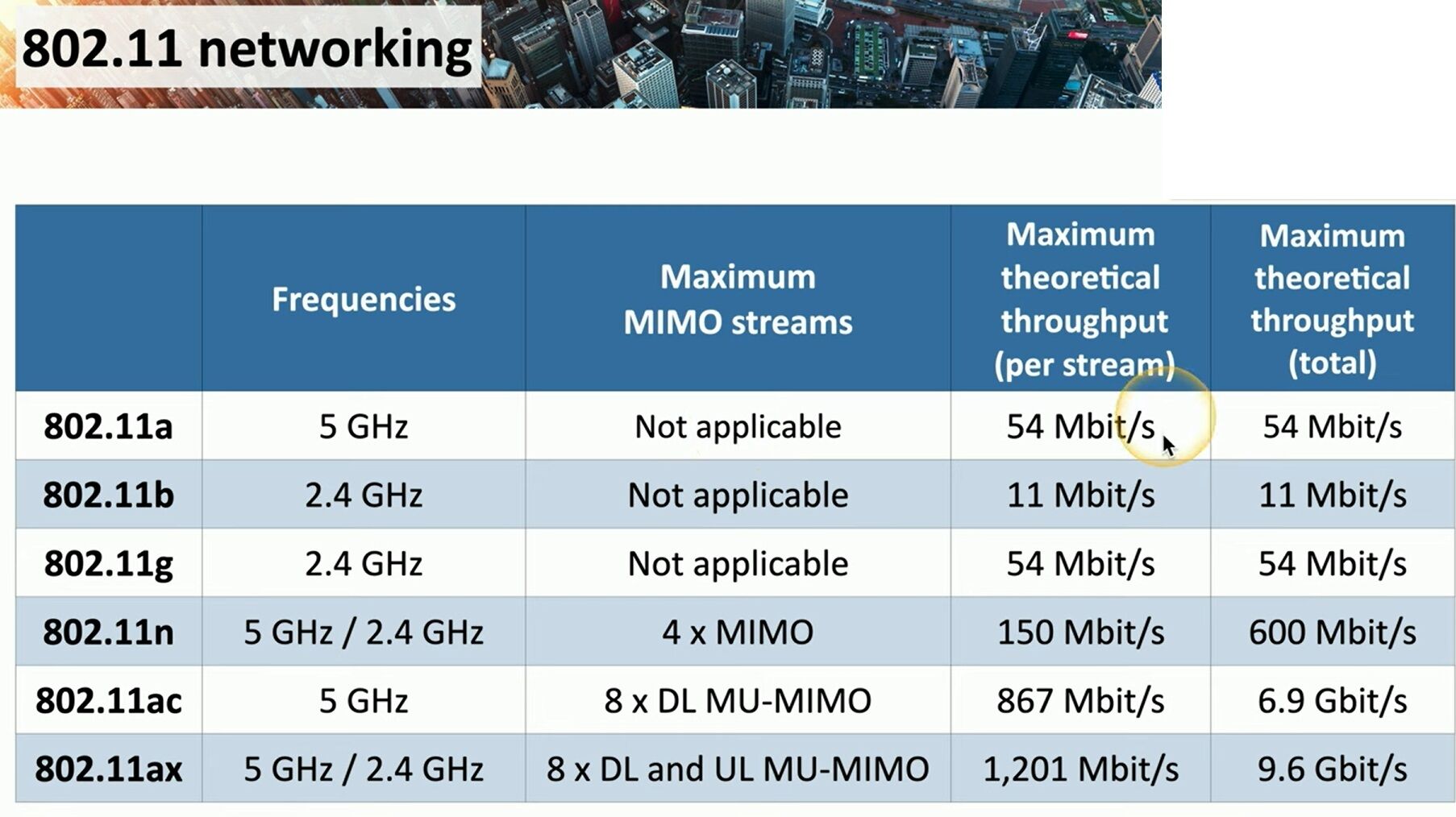
Wireless networking has come a long way, with each generation of the 802.11 standard introducing faster speeds, better bandwidth, and enhanced capabilities. Let’s take a look at the history and advancements of these standards, from 802.11a to 802.11ax.
### **1. 802.11a (1999)**
Introduced in 1999, **802.11a** operates on the 5 GHz frequency and was revolutionary for its time, achieving maximum theoretical throughput of **54 Mbps**. This high frequency helped avoid interference from other devices that commonly use the 2.4 GHz band, but the signal range was shorter, making it better suited for specific indoor environments.
### **2. 802.11b (1999)**
Released the same year as 802.11a, **802.11b** operates on the 2.4 GHz frequency with a maximum throughput of **11 Mbps**. Despite its slower speed, 802.11b became widely popular due to its longer range and compatibility with devices on the crowded 2.4 GHz band. This standard set the stage for wireless internet in home and business environments.
### **3. 802.11g (2003)**
**802.11g** arrived in 2003, combining the benefits of both 802.11a and 802.11b by supporting the 2.4 GHz frequency while reaching speeds up to **54 Mbps**. This standard enabled faster wireless speeds without sacrificing range, which helped it gain widespread adoption as a reliable option for home networking.
### **4. 802.11n (2009)**
The release of **802.11n** in 2009 was a game-changer, as it introduced **MIMO (Multiple Input, Multiple Output)** technology. Operating on both 2.4 GHz and 5 GHz bands, 802.11n supported up to 4 simultaneous data streams, with a maximum theoretical speed of **600 Mbps**. This made 802.11n an ideal choice for households needing to support multiple devices simultaneously, improving overall performance and efficiency.
### **5. 802.11ac (2013)**
In 2013, **802.11ac** brought even more speed and efficiency. Operating exclusively on the 5 GHz frequency, this standard supports **8 simultaneous MU-MIMO (Multi-User MIMO)** streams, reaching a staggering **6.9 Gbps**. The 802.11ac standard further optimized bandwidth for high-definition streaming and faster downloads, making it ideal for modern households with high data demands.
### **6. 802.11ax (2019)**
The latest evolution, **802.11ax** (Wi-Fi 6), introduced in 2019, supports both 2.4 GHz and 5 GHz frequencies and offers **8 simultaneous MU-MIMO streams** in both directions (downlink and uplink), achieving speeds up to **9.6 Gbps**. Known for its improved efficiency, Wi-Fi 6 is designed for environments with many devices, like smart homes, enabling better performance even in high-density areas.
Each step in the evolution of 802.11 networking has contributed to today’s high-speed, low-latency Wi-Fi experience. With Wi-Fi 6, the future of wireless connectivity looks bright, promising even faster speeds and greater device support for our increasingly connected world.
#WiFi6 #WirelessNetworking #80211
 the beginning of matching tips
Leave a comment